
Kaizen:
Whoever believes they are something has stopped becoming something
The sentence in the title has been with me since my youth. I consider it so important that it deserves a blog post of its own.
Who said it first is not settled. It is attributed to Socrates, to the entrepreneur Philip Rosenthal and to others, but none of these attributions is documented.
The thought itself is old. In 1621 a book by John Andrewes contained a Latin sentence that says the same:
Qui cessat esse melior, cessat esse bonus.
Whoever stops getting better stops being good.
Later it was found handwritten in a pocket Bible said to have belonged to Oliver Cromwell.
The Japanese turned this thought into an entire work philosophy. It is called Kaizen.
What does Kaizen mean?
The word consists of two Japanese characters:
“Kai” means change, “zen” means for the better. Together: change for the better.
It means two things. A philosophy of life and work that strives for constant improvement. And a method for improving processes step by step.
The core is small steps. Instead of big upheavals, many small improvements that can be put into practice quickly. In German companies this is known as KVP, the continuous improvement process.
Where does Kaizen come from?
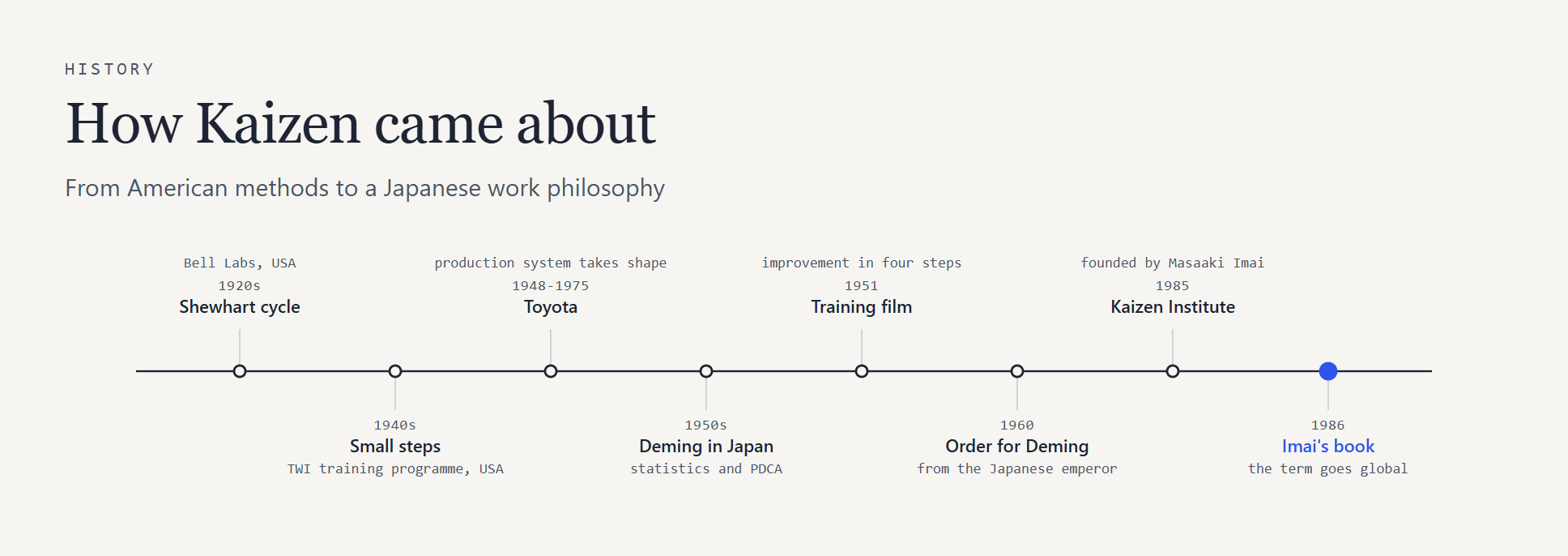
Surprisingly, the story begins in the USA.
1920s:
At Bell Labs, Walter Shewhart describes a cycle for improving quality.
The PDCA cycle later grows out of it.
1940s:
During the Second World War, American industry has no time for major rebuilds.
The training programme Training Within Industry therefore relies on small improvements that can be put into practice on the same day.
After the war:
The Americans help rebuild Japanese industry.
In the 1950s, W. Edwards Deming teaches statistical methods and Shewhart’s cycle there.
With the TWI programme, a training film also arrives in Japan in 1951.
Its title: “Improvement in Four Steps”.
It brings Kaizen as a method into Japanese industry.
Toyota:
Between 1948 and 1975, Taiichi Ohno and Eiji Toyoda develop the Toyota Production System.
To this day Toyota is known for Kaizen:
If someone on the line notices a deviation, they stop the line and look for an improvement together with their supervisor.
1960:
The Japanese emperor awards Deming the Order of the Sacred Treasure for his work.
1985 and 1986:
Masaaki Imai founds the Kaizen Institute and writes the book “Kaizen: The Key to Japan’s Competitive Success”.
The book makes the term known worldwide.
So some of the tools came from the USA. Japanese companies like Toyota turned them into a work philosophy.
How does it work in everyday life?
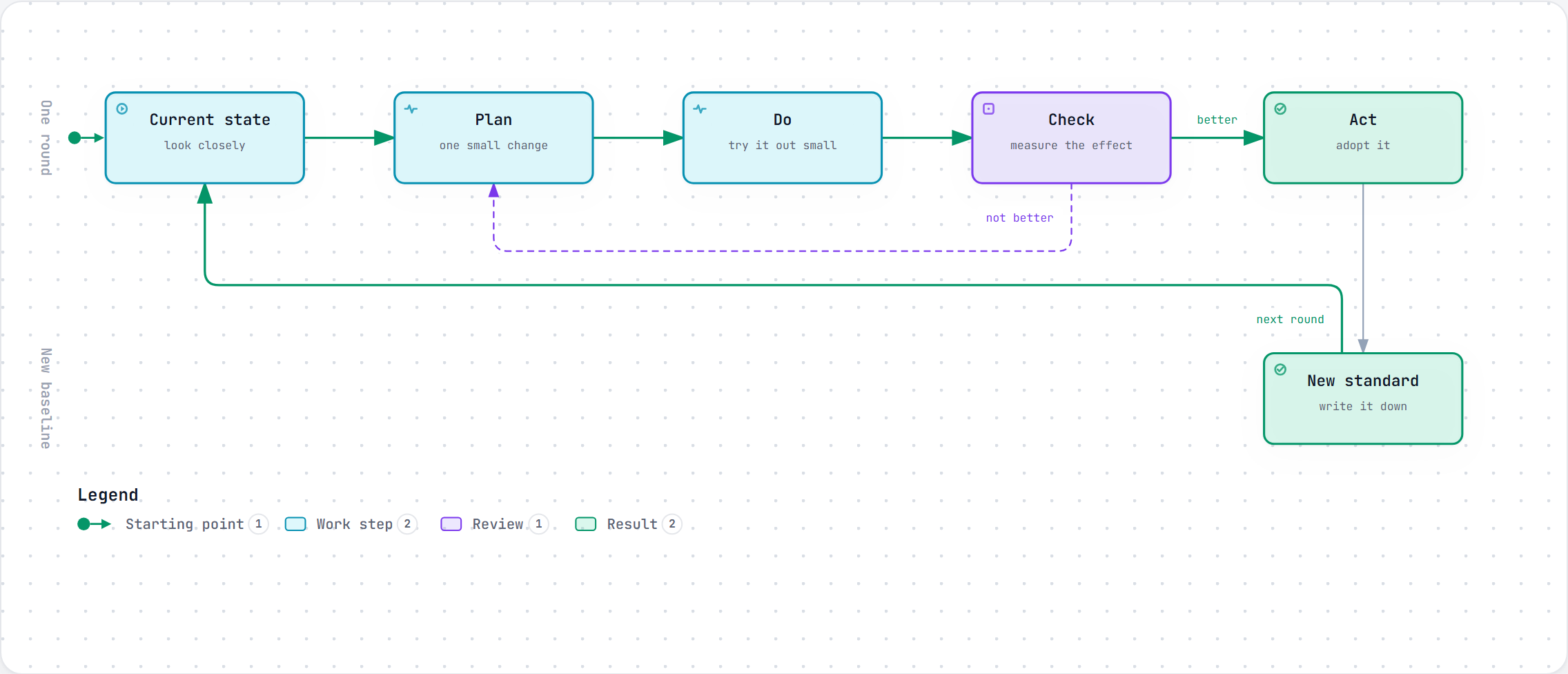
The most important tool is the PDCA cycle. One round has four steps:
- Plan:
Look closely at the current state and plan a small change. - Do:
Try the change out on a small scale. - Check:
Measure whether it has really become better. - Act:
If it is better, the change is adopted. If it is not better, it goes back to planning.
After that, the improvement becomes the new standard. And this standard is the starting point for the next round. So you are never finished.
But be careful:
Kaizen does not mean driving yourself to exhaustion.
Overloading people and machines, in Japanese Muri, is one of the things Kaizen is meant to avoid.
What does this have to do with software projects?
Anyone who works with Scrum already knows a Kaizen round. Every sprint ends with the retrospective. According to the Scrum Guide, its purpose is to plan ways to increase quality and effectiveness. The team looks at what went well, what did not, and what it will do better in the next sprint.
What I have learned from it
Being good is not a state you reach once.
That is why, for me, Kaizen is an attitude to life:
never being satisfied and always striving for perfection.
This applies to every area, to work, to communication and to how we treat other people. It is about becoming a better person.
That is what we should orient ourselves by.
After every project, every conversation and every day, the question is worth asking:
What will I do a little better next time?
Sources: Kaizen (Wikipedia), Kaizen, History (Wikipedia), PDCA (Wikipedia), Toyota Production System (Wikipedia), Masaaki Imai (Wikipedia), Quote Investigator on the origin of the quote, Scrum Guide
The diagrams were created with the skills Archify (PDCA cycle) and SeeCode (timeline) for Claude Code.

Planning a similar project?
I support you from consulting and planning through implementation to quality assurance.